 ID
ID
 EN
EN

Meniscus Physiotherapy
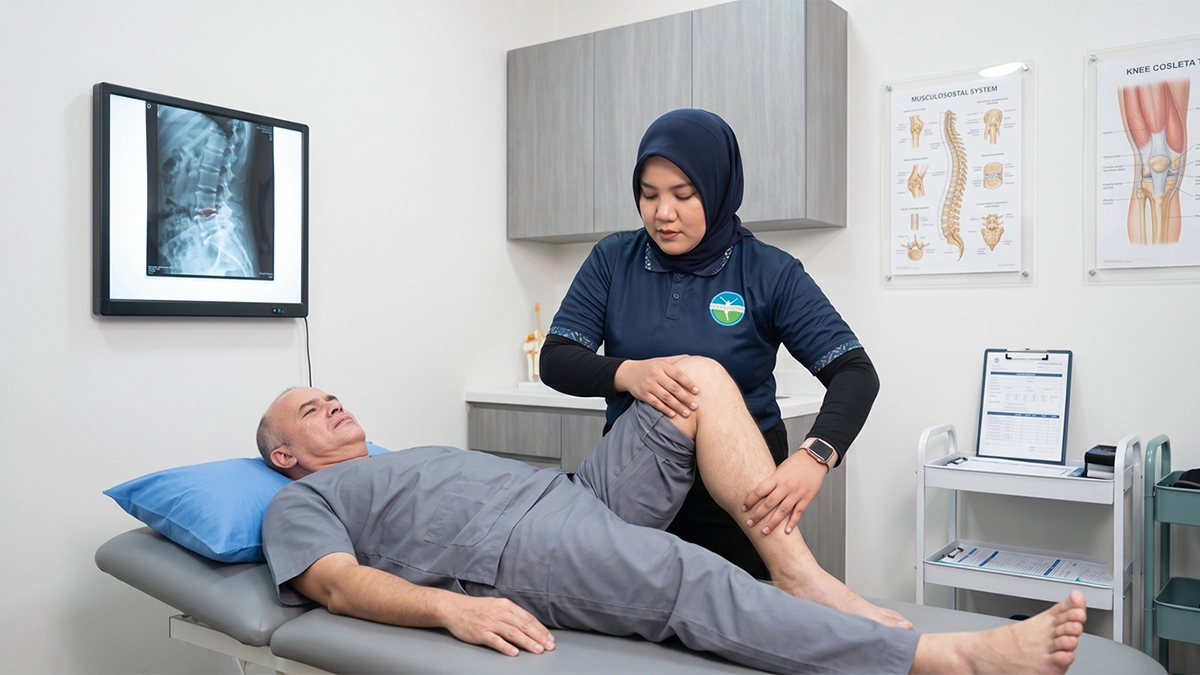
The meniscus is a C-shaped piece of fibrocartilage located within the knee joint that acts as a shock absorber between the femur (thigh bone) and the tibia (shin bone). Each knee contains two menisci—the medial meniscus and the lateral meniscus—which work together to distribute load, absorb impact, and maintain joint stability during walking, running, climbing stairs, and other weight-bearing activities.
Unfortunately, meniscal injuries are often underestimated. As a result, many patients only seek treatment at a physiotherapy clinic after their symptoms have progressively worsened and begun interfering with their daily activities.
The good news is that not all meniscal tears require surgery. According to the 2024 International Consensus Statement developed by orthopedic surgeons and sports physiotherapy experts from Europe and the United States, physiotherapy is recommended as the first-line treatment for degenerative meniscal tears.
This recommendation is further supported by systematic reviews with follow-up periods of up to five years, which found no clinically significant difference in knee function between patients who underwent arthroscopic surgery and those who completed a structured physiotherapy program. In many cases, physiotherapy is not simply an adjunct to treatment—it is the primary pathway to recovery.
Understanding Different Types of Meniscal Tears and Their Treatment
The most appropriate rehabilitation approach depends on the type, location, and severity of the meniscal tear.
Small radial or horizontal tears located in the outer vascular zone (red zone) often respond well to conservative physiotherapy because this region has a good blood supply that promotes healing.
Bucket-handle tears or tears located in the inner avascular zone (white zone) frequently require surgical intervention because of their limited healing potential.
Degenerative meniscal tears, which develop gradually due to aging and cartilage wear, generally respond very well to progressive strengthening programs without surgery.
Acute traumatic tears accompanied by knee instability usually require orthopedic evaluation before determining the most appropriate rehabilitation strategy.
Why the Muscles Around the Knee Are Essential
Many people believe that meniscal rehabilitation focuses solely on reducing pain. In reality, the primary objective is to strengthen the muscles surrounding the knee so they can compensate for some of the shock-absorbing function lost after a meniscal injury.
Strong quadriceps, hamstrings, and gluteal muscles significantly reduce the mechanical load placed directly on the meniscus during walking, stair climbing, standing up from a chair, and other daily activities.
For this reason, comprehensive physiotherapy programs for knee injuries typically address not only the knee itself but the entire kinetic chain, including the hip, pelvis, and ankle, to restore optimal movement mechanics.
Stages of a Meniscus Rehabilitation Program
A structured meniscus rehabilitation program generally progresses through four phases, beginning with pain and swelling management and ending with a safe return to unrestricted activity. Each stage has specific goals and exercises, making it important to complete every phase before progressing to the next.
Phase 1: Pain and Swelling Management (Weeks 1–2)
The initial goal is to reduce pain and inflammation while allowing the knee to move comfortably without placing additional stress on the injured meniscus.
Recommended interventions include:
Apply an ice pack for 15 minutes, 3–4 times daily, over the swollen area.
Modify daily activities by avoiding deep squats, rapid stair climbing, and sudden twisting movements.
Perform isometric quadriceps sets, contracting the thigh muscles without moving the knee for 10 repetitions × 3 sets daily.
Use a walking aid or cane temporarily if weight-bearing remains significantly painful.
Phase 2: Restoring Range of Motion (Weeks 2–4)
Once acute pain and swelling have subsided, rehabilitation focuses on improving flexibility and restoring knee mobility without forcing excessive joint movement.
Typical exercises include:
Controlled heel slides, gradually increasing knee flexion to approximately 100–110 degrees.
Stationary cycling with the seat adjusted to a higher position to minimize compressive forces on the knee.
Gentle hamstring and calf stretching to reduce muscle tightness and prevent compensatory movement patterns.
Gait retraining to restore a normal walking pattern and avoid persistent limping, which can contribute to long-term biomechanical problems.
Phase 3: Progressive Strengthening (Months 1–3)
This stage plays a critical role in determining whether the knee can tolerate everyday loads without recurring pain.
Core strengthening exercises include:
Wall sits, beginning with 20–30 degrees of knee flexion, while avoiding deeper squats (>90°) that place excessive stress on the meniscus.
Low step-ups (10–15 cm) to improve functional strength required for climbing stairs.
Single-leg balance exercises, initially on a stable surface before progressing to unstable surfaces such as foam pads or balance cushions.
Gluteus medius strengthening, including clamshells and side-lying leg raises, to improve hip stability and reduce unwanted rotational stress on the knee.
Physiotherapists commonly monitor progress by assessing:
The ability to perform a partial squat without pain.
Quadriceps strength approaching symmetry with the unaffected leg.
Phase 4: Returning to Full Activity (From Month 3 Onward)
For physically active individuals and athletes, the final stage emphasizes endurance, coordination, and dynamic knee control before returning to unrestricted sports participation.
Typical rehabilitation exercises include:
Light jogging on a flat surface before progressing to uneven terrain.
Agility ladder drills to improve coordination, footwork, and rotational control of the knee.
Jump-landing training, focusing on soft, controlled landings with both feet aligned to minimize excessive knee loading.
Functional performance testing, such as climbing up and down a flight of stairs 10 consecutive times without pain, before clearance for unrestricted sports participation.
The decision to return to full activity should always be based on objective functional assessments, muscle strength, movement quality, and clinical evaluation rather than pain reduction alone.
Assessment Before Starting a Physiotherapy Program
Before designing a rehabilitation program, physiotherapists typically perform a comprehensive assessment to determine the most appropriate treatment approach.
This evaluation commonly includes:
McMurray Test and Apley's Grind Test: Manual orthopedic tests used to identify the location and severity of a meniscal tear.
Range of Motion (ROM) Assessment using a goniometer to compare the injured knee with the unaffected side.
Gait Analysis to evaluate walking mechanics and identify compensatory movement patterns that may have developed as a result of pain.
MRI Review (if available) to confirm the type, size, and location of the meniscal tear before establishing rehabilitation goals.
The findings from these assessments help determine whether the patient is an appropriate candidate for conservative physiotherapy or should first be referred to an orthopedic specialist for further evaluation.
Differences in Meniscus Rehabilitation Across Age Groups
A patient's age significantly influences rehabilitation planning because tissue quality, healing capacity, and recovery goals vary throughout life.
Young and Physically Active Individuals
Rehabilitation is generally more progressive, incorporating plyometric exercises, agility drills, and sport-specific training to facilitate a safe return to high-performance activities.
Middle-Aged Adults with Degenerative Meniscal Tears
The primary focus is on strengthening the muscles surrounding the knee, reducing pain, and restoring everyday function rather than achieving athletic performance.
Older Adults with Coexisting Osteoarthritis
Exercise programs are modified to avoid placing excessive stress on joints already affected by cartilage degeneration. High-impact and heavy resistance exercises are usually minimized.
Patients with Excess Body Weight
Research has shown that reducing body weight by 5–10% can significantly decrease the load placed on the knee joint, improving symptoms and enhancing rehabilitation outcomes.
When Can You Expect to Notice Improvement?
One of the most common questions patients ask is how soon they can expect pain to improve after beginning physiotherapy.
A typical recovery timeline is as follows:
Weeks 1–2: Swelling begins to subside, and pain at rest gradually decreases.
Weeks 3–4: Walking short distances becomes significantly more comfortable.
Weeks 5–8: Most patients are able to climb and descend stairs with little or no pain.
After Month 3: Patients who consistently follow their rehabilitation program can often return to light recreational activities without recurrent symptoms.
If no meaningful improvement is observed after six weeks of consistent physiotherapy, it is important to reassess the diagnosis and tear characteristics rather than simply increasing exercise intensity.
Lifestyle Factors That Support Meniscus Recovery
In addition to a structured rehabilitation program, daily lifestyle habits play an important role in determining how quickly the knee regains strength and stability.
Recommendations include:
Maintain a healthy body weight. Every additional kilogram of body weight increases the load on the knee by approximately four kilograms during walking. Even modest weight loss can noticeably reduce knee stress.
Wear supportive footwear with cushioned soles to reduce repetitive impact on the knee during daily activities.
Avoid prolonged deep squatting, such as during manual household chores or gardening, as this position places considerable pressure on the healing meniscus.
Perform dynamic warm-up exercises before physical activity instead of relying solely on static stretching to better prepare the muscles and joints for movement.
Combining targeted rehabilitation exercises with healthy daily habits leads to more durable long-term outcomes than exercise alone.
Signs That Physiotherapy May Be Sufficient Without Surgery
Many patients can achieve an excellent recovery through physiotherapy alone, particularly when the following conditions are present:
A small tear located in the well-vascularized outer (red) zone of the meniscus.
No symptoms of knee locking or mechanical catching during movement.
Significant pain reduction within the first 2–4 weeks of rehabilitation.
No history of major trauma, such as a high-impact fall or direct collision.
When to Seek Further Evaluation from an Orthopedic Specialist
Although conservative physiotherapy is highly effective for many meniscal injuries, it does have limitations. If the injured tissue fails to respond appropriately to rehabilitation, continuing physiotherapy without further evaluation may delay recovery and allow structural damage to progress.
Patients should seek prompt orthopedic assessment if they experience any of the following:
The knee becomes locked and cannot be fully straightened.
Significant swelling develops suddenly following an acute injury.
Pain remains unchanged after six weeks of consistent physiotherapy.
The knee feels unstable or gives way while walking on uneven surfaces.
Further evaluation may include repeat imaging studies or consideration of surgical intervention when appropriate.
Common Mistakes That Delay Recovery
Many patients are progressing well initially but unintentionally slow their recovery because of avoidable mistakes. Recognizing these habits can help prevent unnecessary setbacks.
Common mistakes include:
Returning to high-impact sports as soon as the pain subsides, even though muscle strength and knee stability have not fully recovered.
Avoiding knee movement altogether out of fear of pain, which can lead to increased joint stiffness and accelerated muscle atrophy.
Neglecting hip-strengthening exercises, despite evidence showing that weak gluteal muscles increase rotational stress on the meniscus.
Skipping regular physiotherapy reassessments, allowing stalled progress to go unnoticed.
When managed appropriately, many meniscal injuries can heal successfully without surgery, particularly when treatment begins early and follows a structured rehabilitation program.
If you would like to determine the type of meniscal tear you have and receive a personalized rehabilitation program tailored to your condition, consult a qualified physiotherapy clinic specializing in knee injuries. An accurate assessment from the outset is far more effective than attempting to guess which exercises are safe to perform on your own.
Frequently Asked Questions (FAQs)
1. Do all meniscal tears require surgery?
No. Small tears located in areas with a good blood supply—particularly degenerative tears—often respond very well to conservative physiotherapy without the need for surgery.
2. How long does meniscus rehabilitation usually take?
Most patients can return to normal daily activities within 6–12 weeks, while returning to sports involving running, pivoting, or rapid directional changes typically requires 3–6 months, depending on the severity of the injury.
3. Can I continue walking while undergoing physiotherapy for a meniscal injury?
Yes. Controlled walking is generally encouraged because complete immobilization can accelerate muscle weakness and delay recovery. Your physiotherapist will advise you on an appropriate level of activity based on your condition.
4. What are the signs that physiotherapy may not be working?
If your pain does not improve after six weeks of consistent rehabilitation or if your knee develops symptoms such as locking or persistent instability, you should return for further assessment. Additional imaging or an orthopedic consultation may be necessary to determine the most appropriate course of treatment.
 Contact Us